Monday, 19 August 2013

Visiting Peñas....

Visiting a Peña while being in Bolivia is a must, especially if you have a stop in La Paz. It is a place where you can feel the enthusiasm and pride of Bolivians for their music and dances.

A Peña is a place where you go for a drink, dance and listen to folkloric-traditional music. When you go there, you can find a wide range of people, people from all ages, Cholitas and their partners, young and old Bolivians, and generally it’s common to see a group of foreign looking at the dance and drinking beer. Some folk music’s are very unique, and only found in the region, so your best bet as a foreign is to copy the steps from your neighbor.

All the time you are at a Peña, you will be listening to folk music all the time. In many, they have live music and performances. You can learn about music there, most Bolivians from middle-class know the names of the music and type of dances.

One of the most famous ones is the Ojo de Agua, Jamuy, Gota de Agua, among others. Most of them are located around downtown area. There is an approx. of 10-30 bolivianos for cover, depending on the demand for the night.


https://www.youtube.com/watch?v=rHhn5ARp6rI

Sunday, 11 August 2013

Coming back to Canada/Independence Day

This week the Bolivian independence day was celebrated. The celebrations coincide with a year of my coming back to Canada. These facts made me very nostalgic to see all over the news all the holiday’s celebration, with the parting and cheerful spirit of nationalism that characterises Bolivians.


The bolivianos I got to meet have a particular sense of pride for their nationality and cultural background; even though they constantly complained about the numerous social problems and constant conflicts around the country, (some even say that peaceful times and consensus are not a characteristic of Andeans). From their early beginning as a Country, they have suffered a wide range of military coups, government changes and/or dictatorships. Evo´s presidency has not been the exception. Himself started his political career involved in several protests and strikes against governmental decision.

Protest and social movements have become an important part of Bolivian culture. With all that is involved, the color ful and protest songs, homogeneous outfits and banners are certainly shocking to foreign visitors. There has not been a time that during a protest, you see some people shooting photos to the crowd. The validity of each one is a matter of long and opposite discussions, but the fact of looking at indigenous groups marching and demanding better living conditions make you have a sense of sympathy to their causes.

That takes me to my year coming back to Canada. After almost a year in Bolivia, you are visually shocked to see things so organized and calm, way different landscape to La Paz. The daily street life is very different, even though people in Canada are more considerate to pedestrians, and generally a cleaner and organized layout in the streets, it lacks that sense of authenticity and culture that is so vibrant and alive in La Paz.


The culture shock was stronger for me as I am a Latin American myself, not standing this as a rule, generally speaking, you can find more commonalities and comfort with your own that others. A year has flown now, and I still feel a big connection with Bolivia, it has become for me my third home.


Sunday, 28 July 2013

Entrada Universitaria (University Parade)

It’s been almost a year since the 2012 university´s dance parade in La Paz. I can still recalled the vibran traditional music all over downtown, the public ready to cheer up, dance and sing with the dancing groups, and each participant getting ready fixing the last minute hair, clothe and make up before the start.
Everyone was taking pictures with other dancer or groups, so you feel as a celebrity for a day. I was lucky to be encouraged to participate as part of the Fraternidad Chacarera Artes. Usually, in Bolivia dancing groups are called Fraternidad (Brotherhood) as they are known for a sense of belonging and loyalty to your group.

Many people have danced more twice or more, I met a lot that it was their tenth or more entrance, so they were pretty relaxed. As a foreign and non-experienced in public performances, I was really nervous. I was concerned about how I would stand those high heels shoes for more than 3 hours in uphill streets, and trying to remember all steps of the choreography.

The event started around 9:00 a.m., from the Downtown-East up to West-End close to the Miraflores stadium. The meeting time for my group was set up at 11 a.m., it was very challenging to get there as the typical traffic jam all over downtown, plus the main streets were blocked.

I was already up at 6:00 a.m., as most of the beauty saloons are booked in advance, you have to book an appointment as early as possible, I was there ready to be transformed in a Chaqueña at 7:00 a.m., it took at least an hour to do your hair and makeup. Every girl was beautifully prepared for the parade; most dances required a breeding hair, fake lashes, sparkling colors around eyes, and hair extensions.

After struggling in finding a taxi that was willing to take to downtown, my dance partner and I stopped for a delicious Silpancho to get energy for the day. I was a bit nervous to be late; however, the city´s Mayor was late so no dance group could start without him.. We needed to wait up to 2 p.m. to start, but we were ready waiting with our group.

Everywhere was full of beautiful colors and exciting energy, there were hair dressers, souvenirs, food, all kinds of stuff, it was possible to enjoy seeing other groups and their amazing outfits.

There were a wide range of groups from all types of dances from all regions of the country. Most of them have either a live music band performing for them, and a theme that differentiates them from others.

Many bands come from other cities like Oruro, where bands for Morenada dance are very famous. For my group, they have Dalmiro Cuellar, a very famous Chacarera singer.


We were all happy and excited to start.. took pictures with friends who were performing and friends who came to see us and provide advice for the dance... Most of it to have fun..

One year from that day, I still miss all the vibe, color and authentic culture in La Paz… with all its chaotic and loud occasions that are part of its attraction. I wish I get to dance and experience that feeling again.


Thursday, 7 June 2012

Linda Cochabmba


During the Eastern long weekend, I had the chance to visit the city of Cochabamba. It is known as the city of the eternal spring as it is lower than La Paz, and its weather is always mild. Is around 1000 meters lower than La Paz, the warm weather plus the lower altitude causes that flowers, green plants and trees be all over the place, a huge contrast when you come from La Paz. It is about six to eight hours trip heading south of La Paz. Even though the distance is around 375 kilometers, the conditions of the highway and its multiple curves (surrounding the mountains), do not allow drivers to go fast, most of the time the average speed is around 50-60 kph.

Unfortunately for me, as a consequence of the Long weekend, most of museums, shops and historic sites were closed. However, I decided to walk around downtown area, where lots of families and kids were hanging out as everybody had the day off. It is nice to see the family environment of the place, and appreciate small joys such as spending all afternoon with friends and relatives around the plaza.


Plaza 16 de Septiembre- Downtown Cochabamba 

Even though Cochabamba city has grown a great deal during the last years, its core downtown remains pretty traditional, you have a sort of feeling that you are in small town. The main plaza is surrounded by the Cathedral, the municipality, and some restaurants. There are plenty of merchants offering their products such as newspapers, balloons and candies for the kids, ice creams, and traditional water with fruits (the popular Bolivian Mocochinci, dry peach in water).

As commonly designed Latin plazas, there is a fountain at the middle of the plaza, a tower with the statue of Condor, a symbol representing the Andes region. The Cholitas (women dressed up with traditional clothes and from indigenous background) here are dressed up in a different way compared to La Paz, their skirt is shorter, and they are not that much covered, most probably because Cochabamba is far warmer than La Paz.

As Eastern Time rules, Catholics have forbidden eating red meat, for this reason most markets were selling fish, mainly from closer lakes. Sellers were offering their fish on the streets, some of them without any ice (I supposed they were really fresh). The vendors take the scams of the fish, and clean and cut the fish in pieces as you request. The markets are full of very diverse fruits and vegetables; especially Bolivia has an amazing diversity in types of potatoes. As Cochabamba is at the center of the country, a great deal of fresh fruits can be purchased at a very affordable price… Chirimoyas, pacay, copoazu….

Women sell their fruits and vegetables on the floor, and if you buy a lot, you can negotiate the price with them.


My favorite fruit so far is Chirimoya, here you can buy one for 50 cents Bs. It seems that most of these fruits are sold in South America, and unfortunately cannot be found easily elsewhere.
Chirimoyas


Saturday, 26 May 2012

Foods in Sucre, Bolivia

During my three days in Sucre, the other capital of Bolivia, I had the chance to try some traditional foods. It seems that the diversity of foods in Sucre is higher than in La Paz, unfortunately, I travel during a long weekend, so it was not possible for me to try all the culinary options available.

Nevertheless, I was suggested not to miss the markets foods. I went to the downtown market and ate at the famous food court called Siete Lunas, very popular for its pork-based sandwiches (Chorizo).

It seems that the place is very popular as most
people were recommending it.

If you are ok eating oily meat and be standing while you eat, then this may be the place to go. Chorizo and other types or meats are the specialty of the small food court.


Another traditional food in Sucre is called Mondongo. A dish based on corn with pork and some chili sauce at the top. As one of the four Sucre's name is Chuquisaca, foods usually are called Chuquisaqueño(a)s.


Finally, another famous food from Bolivia, and in particular a specialty of Sucre is the traditional Salteñas, with quail eggs and olives. Salteñas in Bolivia are usually eaten for breakfast, and/or as a snack before noon. The most famous places open between 8 am to 12 am., it would also be a good choice for breakfast.

Salteñas are a type of traditional Bolivian pastries, made of juicy chicken or beef. Depending on the place, it has diverse ingredients such as potato, onions, garlic, peas, among many others. It is still a type of artisan home-made food, as usually they have to be cooked and eaten the same day, without conservatives. The pastry taste changes if you eat a day-old salteña.

I was told that the name of Salteña comes from a woman from Salta Argentina, who started selling this pastries back on the 19th century, and people started refering to her place as going to buy from the Salteña - a woman from Salta

Saturday, 10 March 2012

Visiting Castillo de la Glorieta…. Sucre


To visit the Castillo de la Glorieta, it is needed to take a 20 min ride from downtown. The Glorieta castle is somehow out of the city, it is located just besides the Military regiment. After you get off the bus, you have to walk around five minutes to get to the Castle. Most people who get off on this final stop are most likely heading there; therefore, there is no way to miss it. The entrance fee is around 15 Bolivianos, with an optional $ 10 extra if you plan to take pictures.

The appearance of the building has a wide range of styles, mainly European; some towers look like a Middle Eastern Palace. The ticket includes a guided tour around all the rooms of the building; approximately it takes around 30-minute to look around all the building while listening to the history of the site and the stories of the Argandoña family who used to live there.

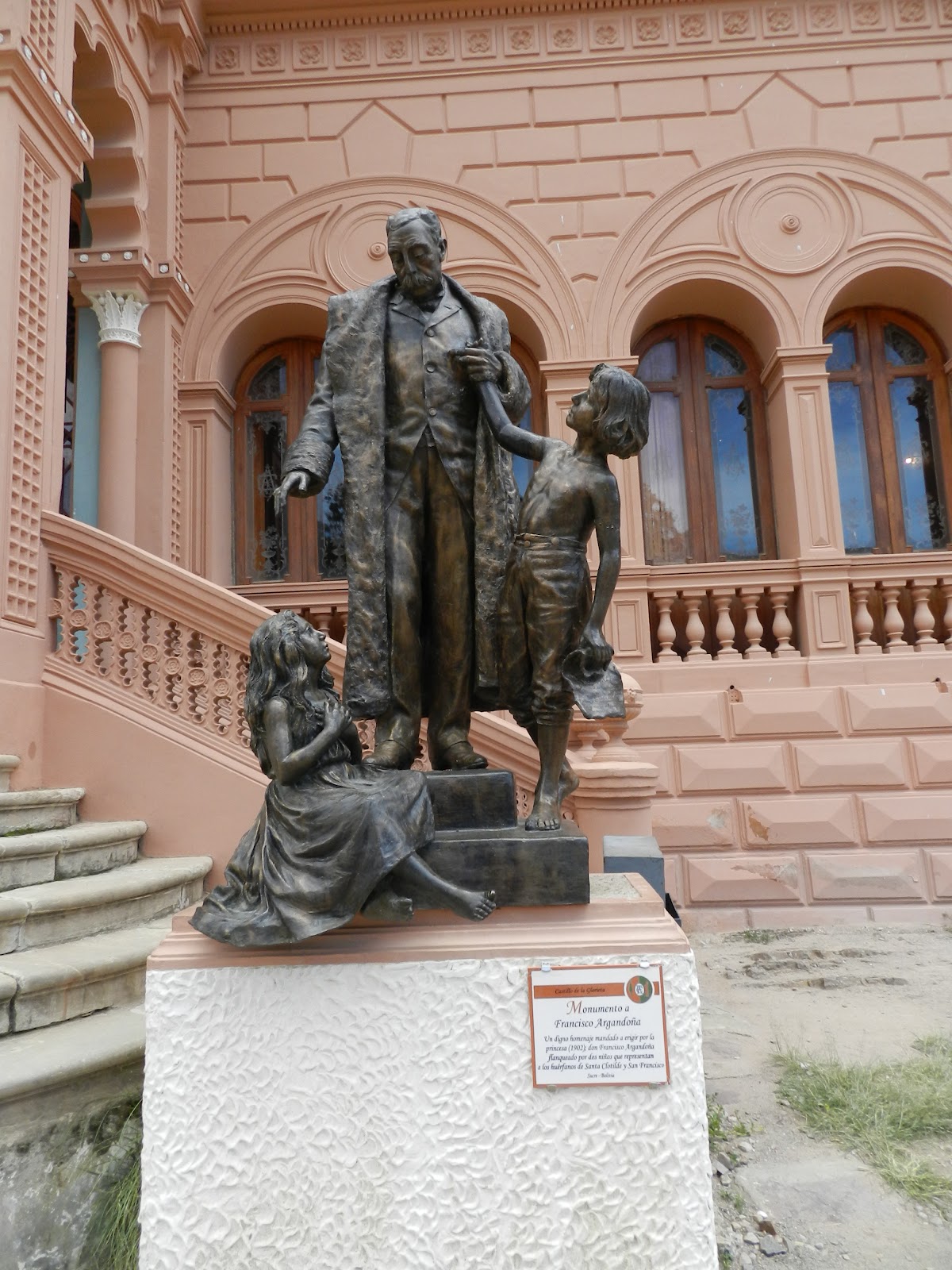
The building was originally owned by Francisco Argandoña y Clotilde Urioste, both from very elite families from Potosi and Sucre. Their marriage made their joined wealth much bigger. They became a very opulent family during early XX century due to the flourished mining industry of the time; as well as a consequence of the industry expansion internationally, particularly during the World Wars.

One of the four Sucre´s names is La Plata (The Silver), as it is located close to the mine at the Cerro Rico, one of the biggest and richest mines in South America.

The wealth of this family is part a result of their mining business; in addition to their diversification in many other industries, such as the banking industry and the Bolivian diplomacy. Both families were highly educated, Francisco Argandoña could speak more than four languages, facilitating business abroad, as well as representing Bolivia internationally.

They hired some of the best designers and architects of the time to build and decorate their castle. The tour guide told us that it was full of persian carpets, elegant and expensive furniture. What still remains are the marble chimneys in some parts of the house, and the ceiling design with some representation of the devil as bats and dragons. There is a theory that people who worked in the mine must worship the Devil (called Tio in Spanish, uncle in English) somehow in order to keep the "Devil" calm and preventing him from doing something terrible.

As a result of their multiple trips to Europe, their choices were influenced by top European styles from the time. Currently, some of their nieces and nephews still have their houses in Paris.

Their wealth shows how highly profitable mining business was at the time, their good management, the affluence of the mines and Bolivian natural resources; the timing and international demands on minerals, all combined made them one of the wealthiest families in America.

Unfortunately for the family, they could not have children, reason that caused the desire of Doña Clotilde to build an orphanage located at the back of their palace. The adopted kids were taught a trade to be able to get a job in the future. As the story is told by the tour guide, these kids were considered as their own, only without inheritance rights and other privileges. It is recalled by the people who knew them that it was compulsory to spend all their Sundays with their adopted kids. Their build some doll houses and games on the backyard for the kids to play, these constructions still remain.

As a result of this social work, and their work in assistance to elders, the Pope Leo XIII gave them the title of Princes of the Glorieta, ceremony that was held in Rome.

Although the Pope gave them this Royalty titles, some historians have the theory that some money was paid to the Vatican to grant this recognition. In the room that supposed to have been their library, still remains some of the family portraits, two of them with the painting of the ceremony when the Pope granted them that order.

It was also said, that they had a very valuable book collection, as the Francisco Argandoña was fluent in many languages. Unfortunately, during the Revolution of 1952, the rebels and indigenous groups came inside the house, and stole or destroyed most of the furniture and books. The only original remaining pieces are the paintings on the walls, which represent their royal life in Europe, the Pope recognition for their charity work, as well as an interesting picture with their kinds, as surprisingly, all of them were painted with white skin and Spanish features.

The castle was abandoned for some years after the Revolution; however, the government has restored part of the furniture and replicated the one missed. Now, it is one of the main Sucre's attractions for tourism.


Sunday, 12 February 2012

Visiting Sucre... Bolivia´s first Capital...

I had the chance to visit the other capital of Bolivia… the White city of Sucre. The city has four names: La Plata, Sucre, Chuquisaca, and Charcas.


Even though the city is only around 700 kilometres south of La Paz, it takes around 12 hours by bus to get there. The bed bus ticket costs around 135 Bolivianos (19 dollars), with very comfortable seats and TV. I heard some bus lines are not very reliable and safe, people recommended me Copacabana or Bolivar lines. Even though, I purchased my ticket at Bolivar, as it supposed to offer the best service, on the highway the driver was stopping to pick up people along the road (who I supposed did not purchase a ticket at the station, and paid him instead)… the inconvenience was that there were no seats available, so they had to sleep on the stairs or on the floor.

I slept all the way up to the time the bus had to make a technical stop for WC. It stopped at a coffee shop in a small town. The shop had no lights, only a few candles. It was raining at that time and there was a huge hole on the middle of the yard, if I had not brought my cell phone lights, I might have fallen down there..Finally we got to Sucre at 8 30 a.m., after almost twelve and half hours on the bus. When the bus arrived, there was marathon happening and the streets were closed around the station, instead of waiting; I decided to directly walk to downtown.

Sucre, as most Latin cities, has its downtown as one the main attractions for tourism. Sucre’s downtown is full of white buildings colonial style; it is clean and less crowded compared to La Paz. The architecture is very beautiful, and the buildings are well maintained. The main plaza, 16 de Mayo is a nice place to relax and contemplate local people who are just hanging out for a walk.


16 de Mayo Plaza 

Even though it is very easy to find hostels and hotels around the downtown, the closer to the main downtown Plaza, 16 de Mayo, the higher the hotel rates becomes. Following the recommendation of my travel advisor book, I stayed at a hostel that is close to the San Francisco Church. As most buildings, it was an old style house that belonged to old-times rich family.

It had a Spanish and colonial architecture; lot of rooms and a big main yard in the middle of the house. Although the place was clean and comfortable, it was kind of freaky at midnight as the furniture was very old, the place had strange noises, it was very scary for me on the dark.


The day after I decided to shop around to see the hotels, I found out many places far nicer that the ones published on those travel books, I recommend hanging a bit around and checking the rooms before checking in a hotel. The second and third night I stayed in another hotel, far nicer and with the same rate that the first one.

There a lots of old government buildings, convents and churches.  The City is UNESCO World Heritage Site for its historic importance as well as for its beauty.  Most of the buildings and houses roofs are red and their front is painted white.  Some streets have posted Cuecas Bolivianas, lyrics of famous romantic songs and dance, on their walls.  It is a relatively small city, with lots of narrow streets. It does not have traffic
jams as La Paz,  it is famous to be a students town as it holds the oldest University on the region. 

Tourism is one of the main activities of the city.  A great deal of tourists are foreign, mainly English speakers.  For this reason, it is very common to see adds and brochures in English (in some places more than in Spanish).


I thought that it was nice to have foreign visitors; however, it is unfortunate that for different reasons, mostly economic, nationals or even Latin people have less chances to see this place.

During my visit, it coincided with a long weekend, for that reason, I had only Saturday to find places open to the public. I went to the tourism information office, where a nice lady gave me a lot of information and brochures with information about the city. There are a lot of interesting museums, and towns around the city. She suggested me to visit first the Castillo de la Glorieta.

Sunday, 15 January 2012

Wires, wires and more wires around La Paz..................


The city of La Paz is full of electric-power wires on the streets.

At first when you arrived, it is impossible not to notice them.... ..After some days, you see them as part of the city landscape.

As you can observe from the pictures, these wires cross each other, to make a very confusing net. These types of poles are almost all over the city; however, it is highly noticeable around the downtown area.


I supposed this was way the poles were built around 80 years ago or so, and for lack of funding or planning, the government has not been able to renewed them and modernize its connections.

For some it is part of the attraction and uniqueness of the place, as very few cities have kept these types of wires..

This is another visible factor that shows the need to work for development and to build infrastructure for the progress of the country. .

Visiting Coroico.....

I had the fortune to have my parents over for the past holidays. At first, I wanted to take advantage of their company, originally I planned going to many places; however, the altitude and time differences cause me to make some last-minute adjustments.

After a couple of days taking them all over La Paz, I decided that our next destination be the town of Coroico.

Coroico is a calm little town around three hours far from La Paz. It is very popular destination as it is considered the capital of the Yungas Region (part of the Andes Mountains series). To get there, we had to take a mini bus from La Paz (Villa Fatima), a small van with around 12 passengers, a bit uncomfortable but still ok for that distance.

The road is full of beautiful landscapes, which certainly are part of the trip attraction.


From the moment you leave the city, you have access to amazing views of the Cordillera Real of the Andes Mountains.
Añadir leyenda

As you go deeper down the mountains, their shape and type starts changing. At the beginning you see very plain type of bold stone mountain, and as soon as the van enters the country side, the vegetation starts increasing up to covering the mountains completely. There are very narrowed curves for a two way road; many times the driver has to press the horn to let the incoming car know that someone is coming.

Coroico is around 2000 meters lower than La Paz; for that reason the climate is warmer, the vegetation is more diverse, you also feel the environment with more oxygen compared to La Paz.

Even though the town is around 120 kilometres far from La Paz, it takes 3 hours to get there.. The road is full of cliffts and curves surrounding the mountains, it is recommended driving at a speed between 30 to 70 km per hour.

The other passengers travelling with us (mainly local people) seemed very relaxed at looking the cliffs out of the window. My parents and I were randomly looking at the rear window, at certain point my mother asked to stop commenting about it (as she got a bit scared).

The two way road is very narrow, and attached to the mountains, that might be a reason few buses take that road.


In the past, there was an alternative road, now called “the dead road” , considered even more dangerous and narrowed than this one.. Now, it has become a popular biking ride. I heard it is an exciting and unique experience, but still I have not been brave enough to try it...


When you arrive to Coroico, you are still surrounded by green mountains; behind them, if you pay attention, it is possible to see the far snowy mountains, making the landscape a unique combination. The town is still very small; it has some hostels, few hotels, and some restaurants. I believe that the downtown should be better maintained, as some parts have garbage and the streets are not in very good conditions. Most of the restaurants and hostels around the main plaza have English signs, one of the villagers told us that there are a lot European tourists coming there.


There is a tourism office, with two tour guides offering a three- hour tour around the town. We decided that it was more convenient to go with a guide than on our own. For a fee, the tour guide took us to the town surroundings, still through more narrow roads. He showed us the coffee and coca leaf plantations, and explained that to harvest coca leaf; peasants need to build a type of terrace in the mountain. He said these types of plantations have been found around the region for centuries.

Yungas has been well known for harvesting coca leaf for a long time. He commented that in the past, during the War on Drugs in South America, the American government sent DEA agents to burn the coca leaf cultivation and to promote harvesting a different crop. After Evo Morales took power, this program was suspended as he explained for reasons of dignity and sovereignty. The tour guide commented that it was sad to see the Bolivian soldiers receiving orders from the Americans in its own land. He also reiterated that coca production around Yungas is very limited in quality for each parcel, and it is for legal purposes.

He believed that Evo Morales has helped the communities around Yungas; especially with programs to learn how to read and write, and he have promoted further education for the indigenous (he said the Yungas has its own university). He commented that if peasants know how to read and write, it is easier for them to do business and understand contracts, not allowing some abuses as he mentioned often happened in the past. He also explained that the land was owned by few land owners, and after the Revolution of 1952, the peasants own and work their own piece of land.

We came back to La Paz the day after, unfortunately I could not take all the available tours. For my experience, I consider that the main attractions of the town are its amazing surroundings and breath taking views. Just to have looked at them made the trip worthed.


As for the town, it is still very small, people go there mainly to relax and take some rest from the busy city. There are many alternative trips for eco-tourism, cascades, the Coroico river; also there are companies offering adventure activities such as zip lines, parapets, canoeing, trekking, yet the main and unique attraction are the fantastic landscapes.


View from the Hotel Gloria, Coroico, Bolivia 


If you like to donate to CUSO Projects....