Saturday, 10 March 2012

Visiting Castillo de la Glorieta…. Sucre


To visit the Castillo de la Glorieta, it is needed to take a 20 min ride from downtown. The Glorieta castle is somehow out of the city, it is located just besides the Military regiment. After you get off the bus, you have to walk around five minutes to get to the Castle. Most people who get off on this final stop are most likely heading there; therefore, there is no way to miss it. The entrance fee is around 15 Bolivianos, with an optional $ 10 extra if you plan to take pictures.

The appearance of the building has a wide range of styles, mainly European; some towers look like a Middle Eastern Palace. The ticket includes a guided tour around all the rooms of the building; approximately it takes around 30-minute to look around all the building while listening to the history of the site and the stories of the Argandoña family who used to live there.

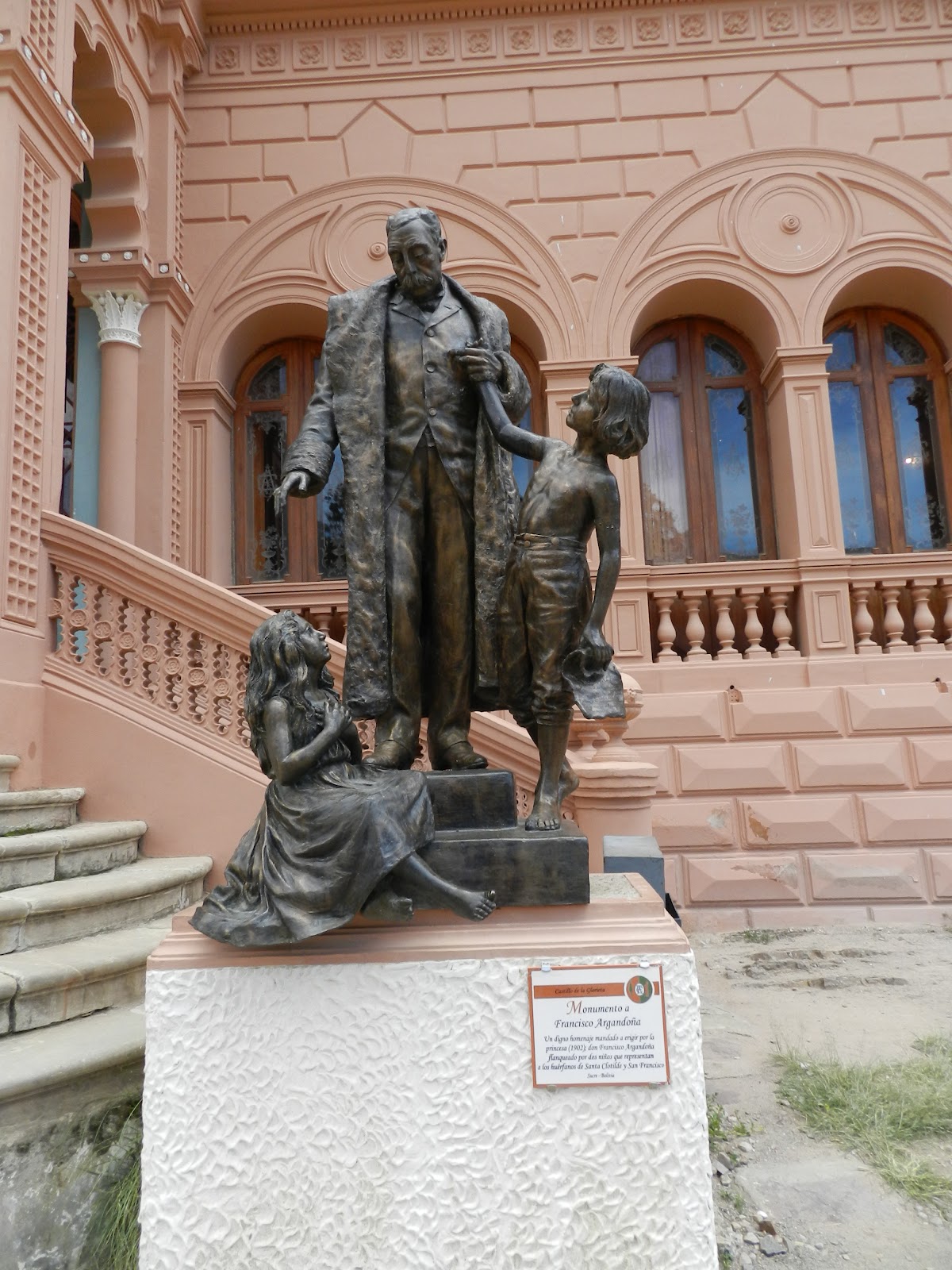
The building was originally owned by Francisco Argandoña y Clotilde Urioste, both from very elite families from Potosi and Sucre. Their marriage made their joined wealth much bigger. They became a very opulent family during early XX century due to the flourished mining industry of the time; as well as a consequence of the industry expansion internationally, particularly during the World Wars.

One of the four Sucre´s names is La Plata (The Silver), as it is located close to the mine at the Cerro Rico, one of the biggest and richest mines in South America.
The wealth of this family is part a result of their mining business; in addition to their diversification in many other industries, such as the banking industry and the Bolivian diplomacy. Both families were highly educated, Francisco Argandoña could speak more than four languages, facilitating business abroad, as well as representing Bolivia internationally.

They hired some of the best designers and architects of the time to build and decorate their castle. The tour guide told us that it was full of persian carpets, elegant and expensive furniture. What still remains are the marble chimneys in some parts of the house, and the ceiling design with some representation of the devil as bats and dragons. There is a theory that people who worked in the mine must worship the Devil (called Tio in Spanish, uncle in English) somehow in order to keep the "Devil" calm and preventing him from doing something terrible.

As a result of their multiple trips to Europe, their choices were influenced by top European styles from the time. Currently, some of their nieces and nephews still have their houses in Paris.

Their wealth shows how highly profitable mining business was at the time, their good management, the affluence of the mines and Bolivian natural resources; the timing and international demands on minerals, all combined made them one of the wealthiest families in America.

Unfortunately for the family, they could not have children, reason that caused the desire of Doña Clotilde to build an orphanage located at the back of their palace. The adopted kids were taught a trade to be able to get a job in the future. As the story is told by the tour guide, these kids were considered as their own, only without inheritance rights and other privileges. It is recalled by the people who knew them that it was compulsory to spend all their Sundays with their adopted kids. Their build some doll houses and games on the backyard for the kids to play, these constructions still remain.

As a result of this social work, and their work in assistance to elders, the Pope Leo XIII gave them the title of Princes of the Glorieta, ceremony that was held in Rome.

Although the Pope gave them this Royalty titles, some historians have the theory that some money was paid to the Vatican to grant this recognition. In the room that supposed to have been their library, still remains some of the family portraits, two of them with the painting of the ceremony when the Pope granted them that order.

It was also said, that they had a very valuable book collection, as the Francisco Argandoña was fluent in many languages. Unfortunately, during the Revolution of 1952, the rebels and indigenous groups came inside the house, and stole or destroyed most of the furniture and books. The only original remaining pieces are the paintings on the walls, which represent their royal life in Europe, the Pope recognition for their charity work, as well as an interesting picture with their kinds, as surprisingly, all of them were painted with white skin and Spanish features.

The castle was abandoned for some years after the Revolution; however, the government has restored part of the furniture and replicated the one missed. Now, it is one of the main Sucre's attractions for tourism.


Sunday, 12 February 2012

Visiting Sucre... Bolivia´s first Capital...

I had the chance to visit the other capital of Bolivia… the White city of Sucre. The city has four names: La Plata, Sucre, Chuquisaca, and Charcas.


Even though the city is only around 700 kilometres south of La Paz, it takes around 12 hours by bus to get there. The bed bus ticket costs around 135 Bolivianos (19 dollars), with very comfortable seats and TV. I heard some bus lines are not very reliable and safe, people recommended me Copacabana or Bolivar lines. Even though, I purchased my ticket at Bolivar, as it supposed to offer the best service, on the highway the driver was stopping to pick up people along the road (who I supposed did not purchase a ticket at the station, and paid him instead)… the inconvenience was that there were no seats available, so they had to sleep on the stairs or on the floor.

I slept all the way up to the time the bus had to make a technical stop for WC. It stopped at a coffee shop in a small town. The shop had no lights, only a few candles. It was raining at that time and there was a huge hole on the middle of the yard, if I had not brought my cell phone lights, I might have fallen down there..Finally we got to Sucre at 8 30 a.m., after almost twelve and half hours on the bus. When the bus arrived, there was marathon happening and the streets were closed around the station, instead of waiting; I decided to directly walk to downtown.

Sucre, as most Latin cities, has its downtown as one the main attractions for tourism. Sucre’s downtown is full of white buildings colonial style; it is clean and less crowded compared to La Paz. The architecture is very beautiful, and the buildings are well maintained. The main plaza, 16 de Mayo is a nice place to relax and contemplate local people who are just hanging out for a walk.


16 de Mayo Plaza 

Even though it is very easy to find hostels and hotels around the downtown, the closer to the main downtown Plaza, 16 de Mayo, the higher the hotel rates becomes. Following the recommendation of my travel advisor book, I stayed at a hostel that is close to the San Francisco Church. As most buildings, it was an old style house that belonged to old-times rich family.

It had a Spanish and colonial architecture; lot of rooms and a big main yard in the middle of the house. Although the place was clean and comfortable, it was kind of freaky at midnight as the furniture was very old, the place had strange noises, it was very scary for me on the dark.


The day after I decided to shop around to see the hotels, I found out many places far nicer that the ones published on those travel books, I recommend hanging a bit around and checking the rooms before checking in a hotel. The second and third night I stayed in another hotel, far nicer and with the same rate that the first one.

There a lots of old government buildings, convents and churches.  The City is UNESCO World Heritage Site for its historic importance as well as for its beauty.  Most of the buildings and houses roofs are red and their front is painted white.  Some streets have posted Cuecas Bolivianas, lyrics of famous romantic songs and dance, on their walls.  It is a relatively small city, with lots of narrow streets. It does not have traffic
jams as La Paz,  it is famous to be a students town as it holds the oldest University on the region. 

Tourism is one of the main activities of the city.  A great deal of tourists are foreign, mainly English speakers.  For this reason, it is very common to see adds and brochures in English (in some places more than in Spanish).


I thought that it was nice to have foreign visitors; however, it is unfortunate that for different reasons, mostly economic, nationals or even Latin people have less chances to see this place.

During my visit, it coincided with a long weekend, for that reason, I had only Saturday to find places open to the public. I went to the tourism information office, where a nice lady gave me a lot of information and brochures with information about the city. There are a lot of interesting museums, and towns around the city. She suggested me to visit first the Castillo de la Glorieta.

Sunday, 15 January 2012

Wires, wires and more wires around La Paz..................


The city of La Paz is full of electric-power wires on the streets.

At first when you arrived, it is impossible not to notice them.... ..After some days, you see them as part of the city landscape.

As you can observe from the pictures, these wires cross each other, to make a very confusing net. These types of poles are almost all over the city; however, it is highly noticeable around the downtown area.


I supposed this was way the poles were built around 80 years ago or so, and for lack of funding or planning, the government has not been able to renewed them and modernize its connections.

For some it is part of the attraction and uniqueness of the place, as very few cities have kept these types of wires..

This is another visible factor that shows the need to work for development and to build infrastructure for the progress of the country. .

Visiting Coroico.....

I had the fortune to have my parents over for the past holidays. At first, I wanted to take advantage of their company, originally I planned going to many places; however, the altitude and time differences cause me to make some last-minute adjustments.

After a couple of days taking them all over La Paz, I decided that our next destination be the town of Coroico.

Coroico is a calm little town around three hours far from La Paz. It is very popular destination as it is considered the capital of the Yungas Region (part of the Andes Mountains series). To get there, we had to take a mini bus from La Paz (Villa Fatima), a small van with around 12 passengers, a bit uncomfortable but still ok for that distance.

The road is full of beautiful landscapes, which certainly are part of the trip attraction.


From the moment you leave the city, you have access to amazing views of the Cordillera Real of the Andes Mountains.
Añadir leyenda

As you go deeper down the mountains, their shape and type starts changing. At the beginning you see very plain type of bold stone mountain, and as soon as the van enters the country side, the vegetation starts increasing up to covering the mountains completely. There are very narrowed curves for a two way road; many times the driver has to press the horn to let the incoming car know that someone is coming.

Coroico is around 2000 meters lower than La Paz; for that reason the climate is warmer, the vegetation is more diverse, you also feel the environment with more oxygen compared to La Paz.

Even though the town is around 120 kilometres far from La Paz, it takes 3 hours to get there.. The road is full of cliffts and curves surrounding the mountains, it is recommended driving at a speed between 30 to 70 km per hour.

The other passengers travelling with us (mainly local people) seemed very relaxed at looking the cliffs out of the window. My parents and I were randomly looking at the rear window, at certain point my mother asked to stop commenting about it (as she got a bit scared).

The two way road is very narrow, and attached to the mountains, that might be a reason few buses take that road.


In the past, there was an alternative road, now called “the dead road” , considered even more dangerous and narrowed than this one.. Now, it has become a popular biking ride. I heard it is an exciting and unique experience, but still I have not been brave enough to try it...


When you arrive to Coroico, you are still surrounded by green mountains; behind them, if you pay attention, it is possible to see the far snowy mountains, making the landscape a unique combination. The town is still very small; it has some hostels, few hotels, and some restaurants. I believe that the downtown should be better maintained, as some parts have garbage and the streets are not in very good conditions. Most of the restaurants and hostels around the main plaza have English signs, one of the villagers told us that there are a lot European tourists coming there.


There is a tourism office, with two tour guides offering a three- hour tour around the town. We decided that it was more convenient to go with a guide than on our own. For a fee, the tour guide took us to the town surroundings, still through more narrow roads. He showed us the coffee and coca leaf plantations, and explained that to harvest coca leaf; peasants need to build a type of terrace in the mountain. He said these types of plantations have been found around the region for centuries.

Yungas has been well known for harvesting coca leaf for a long time. He commented that in the past, during the War on Drugs in South America, the American government sent DEA agents to burn the coca leaf cultivation and to promote harvesting a different crop. After Evo Morales took power, this program was suspended as he explained for reasons of dignity and sovereignty. The tour guide commented that it was sad to see the Bolivian soldiers receiving orders from the Americans in its own land. He also reiterated that coca production around Yungas is very limited in quality for each parcel, and it is for legal purposes.

He believed that Evo Morales has helped the communities around Yungas; especially with programs to learn how to read and write, and he have promoted further education for the indigenous (he said the Yungas has its own university). He commented that if peasants know how to read and write, it is easier for them to do business and understand contracts, not allowing some abuses as he mentioned often happened in the past. He also explained that the land was owned by few land owners, and after the Revolution of 1952, the peasants own and work their own piece of land.

We came back to La Paz the day after, unfortunately I could not take all the available tours. For my experience, I consider that the main attractions of the town are its amazing surroundings and breath taking views. Just to have looked at them made the trip worthed.


As for the town, it is still very small, people go there mainly to relax and take some rest from the busy city. There are many alternative trips for eco-tourism, cascades, the Coroico river; also there are companies offering adventure activities such as zip lines, parapets, canoeing, trekking, yet the main and unique attraction are the fantastic landscapes.


View from the Hotel Gloria, Coroico, Bolivia 


Sunday, 8 January 2012

Bolivia Querida ................

For those who might not know much about Bolivia, I would like to share some insights, comments and information that local people have shared with me, as well as some facts that I have witnessed and experienced while living in La Paz for almost three months. Bolivia is a very diverse country; it has multiple languages, people, geography, weather, classes, among many other subjects. 

Bolivia's geographical location contributes to its challenges for improvement and development.

As it is located between Andes (world's longest mountain range) and Amazons (one of the world's biggest jungles), it is challenging to build roads and to commute between villages, causing that people from different regions have dissimilar priorities. This plurality increases visions and ideologies intended towards development.


Bolivia is a country in South-America with more ethnics and/or indigenous groups, and the one where an indigenous became President: Evo Morales.

There is a lot of debate around whether having Evo Morales as president of Bolivia has improved the conditions of the country. For some, Evo's policies has been highly detrimental in terms of progress and development; as such policies have resulted in a decreased regional competitiveness, lack of business promotion, increased government ownership of key industries and bureaucracy, as well as a deficient inclusion of the private sectors in public policies, among many other criticisms.

Since the time Evo took power as president, as well as the leader of the coca trade union, he has promoted a socialism ideology (his political party name is MAS - Movement for Socialism) with an "anti-imperialism discourse" (as he refers to Capitalism and American influence). During this government, some of the key industries such as telecommunications, gas, hydrocarbons and electricity have been nationalized. A new Constitution was created in 2009, giving more rights and recognition to indigenous and less advantaged groups, as well as creating laws to enforce inclusion and equality. An anti-capitalist, anti - neoliberal, anti-American content is usually part of his political discourse, recalling the past as the period where upper classes abused and committed injustices against the less advantaged and indigenous groups. A second flag (Whipala) has been promoted to represent all indigenous communities (36 nations).

Some people have told, that after Evo took power, there were times that men wearing tie had to take it off before going out to the street to avoid confrontation. Some groups from indigenous background would cut men's ties with scissors arguing that it represents the western influence of supremacy and oppression. A new Vice-Ministry of Decolonization was created to promote indigenous history, knowledge and values, and to support initiatives aimed at decreasing “western influence” in education and lifestyles. I have heard on the radio, spots mentioning to denounce any type of discrimination as a result of gender, race or social status. Also, I have seen signs in stores and public places (restaurants, movies, hotels), where it is highlighted the law against discrimination.

On the other hand, some people highlight the government merits in promoting independence from American policies and in finding its own way of progress and development. Helping the most vulnerable sectors of society, and giving “bonuses” to elder people, pregnant women, students, (very low amounts, but a lot of advertisement about it) have been part of the initiatives. All these actions had Evo Morales reelected in 2009, and resulted that the parliament majority come from the same political party as the President (MAS, Movement for Socialism).

Nevertheless, the government policies have highly empowered some indigenous groups, for instance people from indigenous backgrounds currently have very high level governmental positions (see the list of government ministers and profiles here), something that was impossible during past governments. Also, there are numerous of civil movements created by indigenous and peasants groups. Still, I constantly hear the analogy that having a high level position is not a matter of being indigenous or not, handling that level of public responsibility to someone without formal education is like allowing someone without knowledge of planes to be a pilot, with the country as the crew.

Another important issue has been the expel of the US ambassador in Bolivia due to suspected interest against the government of Morales, as well as for having meetings with the government opposition groups. US had policies to eradicate coca leaf cultivation, (which is processed to produce cocaine), and to promote that peasants harvest crops different than coca leaf. This project was not as successful as planned, coca leaf is still more profitable than harvesting any type of fruits or vegetables, therefore, peasants are very reluctant to change. I heard comments that is very well known that around the region of Chapare, part of the city of Chochabamba, coca leaf is produced for illegal purposes, there is a suspicion that the government is very relaxed about it. Coca leaf has been part of the local culture for centuries, it is very common to see people chewing coca leaf or drinking coca tea. The leaf per se does not produce harm or addiction; however, after being processed it becomes one of the most addictive, demanded and expensive drugs cocaine.

Recently, some of the groups who had initially supported the President, have started protesting against his policies.

In December 2010, the President announced a decrease on gasoline subsidies, and therefore a raise in

gas prices. There were protests against this decision all over the country, causing the government to step back and maintain subsidizing the gas. Nevertheless, the initial message caused significant speculation and inflation, affecting the economy anyways.(Gasolinazo is the Spanish term used for that announcement to increase gas prices). In 2011, the government initiated a plan to build a highway across an indigenous area (Parque Nacional y Territorio IndígenaIsiboro-Secureor Territorio Indígena y Parque Nacional Isiboro Secure, TIPNIS). The local indigenous groups came to La Paz to protest against the construction of the highway, arguing that it will damage the environment and pollute the local culture. At the end, the government stepped back and declared a law so the area be intangible, and as a result the road plan was cancelled. Still, this issue is not completely resolved, as some groups do not agree that the area be considered as intangible, and they are not in La Paz protesting for that law.

With all these challenges (and many many more), the government statistics show that Bolivia is doing relatively well. Bolivia's economy is still very dependent on the production of raw materials, and that is why it has benefited from the international high prices of gas and minerals; yet it is risky for the country to depend on such sectors, as there is no control over these prices. The government has also decreased its debts with foreign institutions (IMF, WB, BID, - however it has increased its loans from Venezuela).


Bureaucracy remains as one of the main problems as well as lack of security for business and investors. According to the World Bank, Bolivia ranking is 154 out of 183 countries, in terms of how easy is to invest and open a business here.

There is a lot of informal commerce (considered as almost half of the jobs), lack of infrastructure and transportation systems and reliable services among many other challenges that the country needs to address to have better conditions. Even though some sectors have improved their living conditions, still according to the World Bank, 61% of the population live under poverty levels, one of the highest rates in the continent. Also, the Human Development Index ranks Bolivia in the position 108, a very poor result comparing to the neighbor countries (Peru 80, Chile 44).

There is no doubt that there are significant challenges, as all Latin American countries need to address. However, it is confusing to understand the reality with very radical and polarized positions (left and right wing parties), and lack of reliable information. I guess this adds up to the challenge for this country; as more diversity and democracy are supposed to be positive concepts, but having too much of them may cause divisions and lack of effective and appropriate policies to work towards the so needed development.

Market, Feria 16 de Julio, El Alto, Bolivia 


Wednesday, 14 December 2011

More than a month already in La Paz.................


It has been more than a month already in La Paz.

By now sometimes I feel that the honey-moon of living in Bolivia has evolved to culture shock. I started experiencing the routine daily life, where the noise of the cars horns all day long , the inconvenience of the weekly protests in downtown, lack of courtesy of some drivers to pedestrians, contaminated street foods, poor customer service in some places, to list some challenges people have to deal with every day. In addition to loneliness at times, as a result of being far from friends and family.

As my frustration comes, I thought about the local people, whom most probably have to deal with these issues most of their life, some of them with few opportunities for a change. Afterwards, I feel ungrateful for complaining, at the end of the day I am only a temporarily spectator and somehow privileged to have the chance to value some things I took for granted, and get out a bit of my comfort zone. Ultimately, dealing with new challenges, is part of the learning process of being in a new Country.

One of these last days while complaining to myself that I had to walk home under the rain (as it is almost impossible to catch any type of transportation while a protest is happening), I saw some young people laughing and enjoying walking under the rain, I was thinking that sometimes we assume that having the so called "developed infrastructure" and comfort result in happiness.
 Many people have not experienced the convenience of bus schedules, customer services departments in stores, preference for pedestrians ......... and still find their way to enjoy life.


I must work with my tolerance for my own sake. I hope that my cultural adaptation moves quickly to the recovery stage, as well as my capacity to keep things in perspective.

Friday, 9 December 2011

Stop by the Cemetery ..................


Last Sunday while going to the neighbor city of El Alto, I had to change busses at Buenos Aires Street, which happens to be in front of the city´s cemetery. To my surprise it was extremely crowded, there was a huge traffic jam at least two streets before the taxi could get there. At first¸ I thought there was a protest happening or that it was the month of November, as in some Latin countries during this month, people celebrate all saints or the day of the dead.

However, I asked the minibus driver and a street vendor, and both of them told me that Sundays all year round are like that. It is a tradition for people to visit the graves of their beloved who rest in the cemetery.


At the front of the main entrance, it is packed of street vendors selling from fruits and vegetables, to flowers and sprays for the graves. In addition, just crossing the street, there is a market exclusively for beautiful and colourful flowers that are sold for a decent price. The vendors insist asking people to come closer to their shop to see the flowers from close. Most people who entered the cemetery were with their families in order to transmit this tradition. I appreciate the unity of the families and the remembrance of their relatives who passed away. Beyond the superstition and religion traditions, the fact that people get together and keep bonded with their relatives is a great value that still distinguishes Latin cultures....

If you like to donate to CUSO Projects....